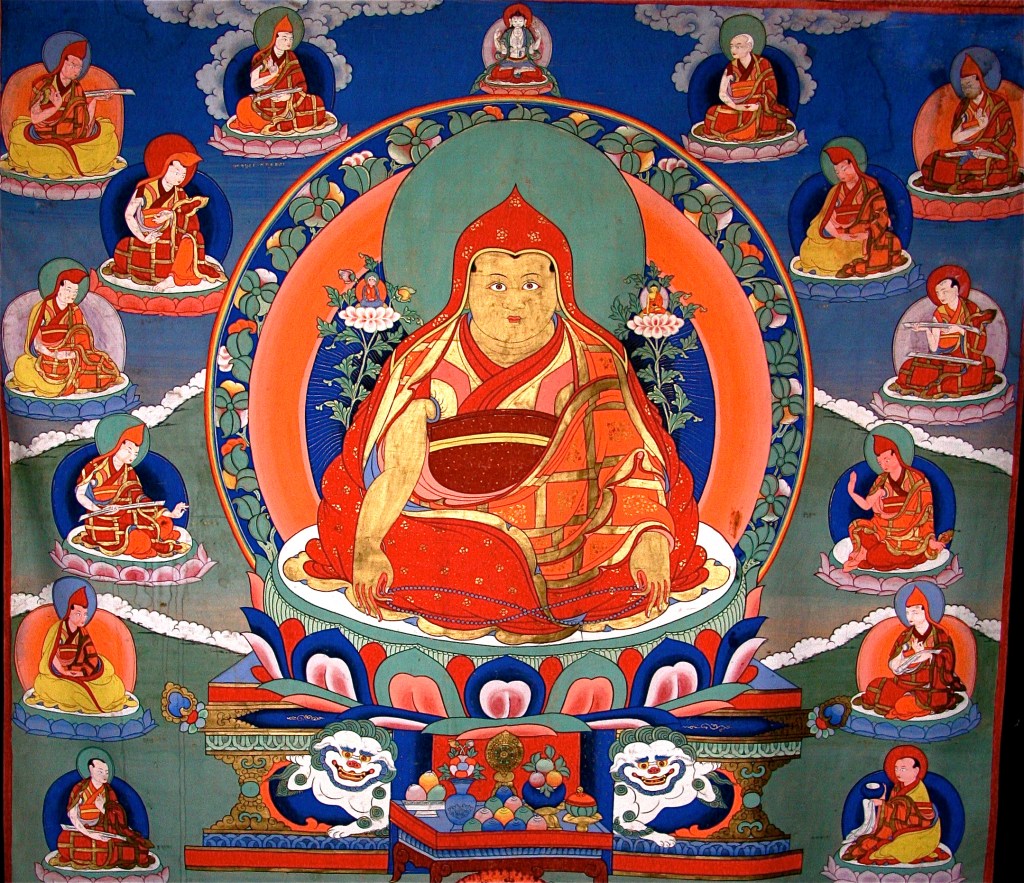
Tārānatha’s connection to the Jonang starts with his recognition as the incarnation of the renowned Sakya, Shangpa Kagyu and then 24th Jonang head, Kunga Drolchog (1507-1566).

For about the last twenty years of his life Kunga Drolchok was the twenty-fourth holder of the monastic seat of Jonang Monastery, retaining this position until his death in 1566. He was succeeded on the Jonang throne by his nephew, Kunga Pelzang (kun dga’ dpal bzang, 1513-1593). The Treasury of Lives Tāranātha biography states that:
“According to tradition, when he was about one year old he declared, “I am master Kunga Drolchok!” But this was kept secret for several years, and it was not until he was about four years old that he was brought to Kunga Drolchok‘s (kun dga’ grol mchog, 1507-1566) seat of Cholung Jangtse Monastery (chos lung byang rtse) and formally recognized as his incarnation. He then began years of intense study and practice under the guidance of a series of great masters, many of whom had been major disciples of Kunga Drolchok.
Guided by Kunga Drolchok’s disciple Jampa Lhundrub (byams pa lhun grub, d.u.), Tāranātha first studied and mastered various subjects of sutra and tantra. Then he received a vast number of tantric teachings and initiations, primarily of the Sakya tradition of Lamdre, from another of his predecessor’s disciples, Doring Kunga Gyeltsen (rdo ring kun dga’ rgyal mtshan, d.u.).
Kunga Drolchok’s disciple Draktopa Lhawang Drakpa (brag stod pa lha dbang grags pa, d.u.) taught Tāranātha many esoteric instructions, especially the Six Yogas and Mahāmudrā. Jedrung Kunga Pelzang (rje drung kun dga’ dpal bzang, 1513-1588), who was Kunga Drolchok’s nephew and successor on the monastic seat of Jonang Monastery (jo nang dgon), transmitted to Tāranātha the teachings of Kālacakra and the dharma protector Mahākāla that he had received from his uncle.
From Kunga Drolchok’s disciple Lungrik Gyatso (lung rigs rgya mtsho, d.u.), Tāranātha received many transmissions, especially the Kālacakra initiation, the explanation of the Kālacakra Tantra, the esoteric instructions of the Six-branch Yoga according to the Jonang tradition, and the collected writings Dolpopa Sherab Gyeltsen (dol po pa shes rab rgyal mtshan, 1292-1361). He is said to have gained a special experiential realization when he practiced the Six-branch Yoga.”
For more resources on Tāranātha’s Life-Stories, see the website section here.
 Tāranātha's Collected Works